Miss Chase
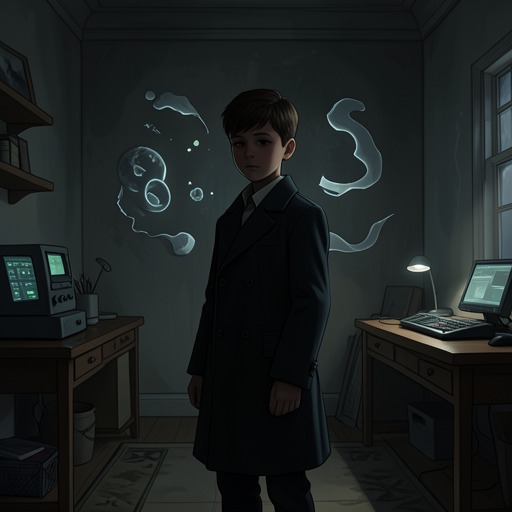
The People UpstairsMiss Chase is Terence Greene’s schoolteacher, a figure whose authority embodies the ordinary Earth culture into which he has been placed. She is not presented through a private history or an independent storyline; her importance lies in the certainty with which she interprets the world for her pupils. Because Terence Greene is a Milotan child born on Earth and hidden behind costly biological disguises, Miss Chase’s classroom becomes one of the principal forces shaping his mistaken sense of belonging.
Classroom Authority and Earthbound Certainty
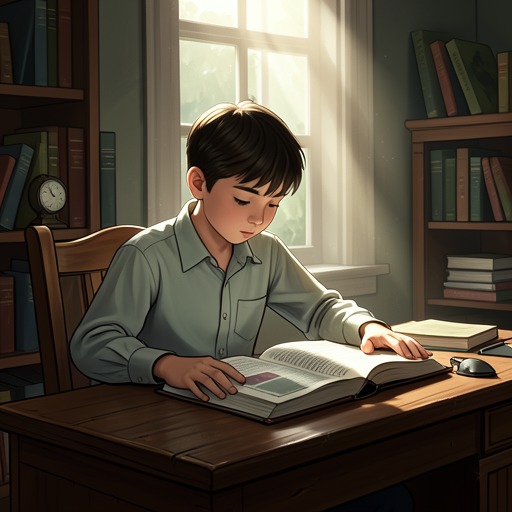
Miss Chase teaches that there are no inhabitants on other planets and that space travel does not exist. She also discourages comic books in favor of serious reading and preparation to become good citizens. Her claims are delivered as settled knowledge rather than as questions open to investigation, so her role exceeds that of a source of academic instruction: she supplies Terence Greene with the official limits of the imaginable. To him, the teacher’s confidence carries more immediate weight than the guarded, partial explanations offered at home.
That authority produces a sharp conflict when Dan Greene tells Terence Greene that the family comes from another planet and another solar system. Terence Greene first treats the disclosure as a joke, then invokes Miss Chase as proof that the entire idea is silly. Dan Greene can only answer that there are many things Miss Chase does not know. Terence Greene replies that she is the teacher, making the issue less a contest between two facts than a contest between two structures of trust: parental secrecy, which has protected him, and classroom authority, which has taught him how a respectable Earth child should understand reality.
Civic Lessons and the Misreading of Origins
Miss Chase’s teaching also gives Terence Greene an available explanation for his parents’ foreignness. When he asks whether they come from Russia, she has taught him that there is nothing wrong with being Russian, that people may flee a bad government without being ashamed of their nationality, and that such people should help make Russia a good country like the United States. Her lesson is humane within its own political frame, but it remains entirely terrestrial. It cannot account for parents who are neither Russian nor Chinese, but agents from Milotis whose bodies have been altered for a lifetime assignment on Earth.
Terence Greene consequently tries to fit the impossible revelation into the categories Miss Chase has supplied. He asks whether China explains the masks, then objects that Chinese people are yellow rather than green. The question shows how school knowledge has equipped him to recognize national difference while leaving him unable to conceive of species difference. Miss Chase’s framework can distinguish one terrestrial population from another, but it offers no language for a child whose face, skin, hands, and contact lenses have been made to pass as human.
The Satellite and the Limits of Correction
The first Russian satellite might have challenged Miss Chase’s rejection of space travel. Dan Greene and May Greene hope that a visible technological achievement will force her, and through her Terence Greene, to reconsider the claim that extraterrestrial life and space travel are merely foolish notions. Instead, Miss Chase dismisses the satellite as Russian propaganda. The event therefore confirms her characteristically closed method: evidence that falls outside her understanding is not examined but discredited.
Her dismissal has consequences beyond one lesson. Terence Greene continues to regard himself as stubbornly Earthbound. When his parents try to teach him the geography and history of Milotis, he treats the material as a joke or pretends to do so, as though the subject were an embarrassing fantasy that has already been repeated too often. His resistance develops alongside a growing discomfort with Milotan, which he first feels embarrassed to speak and later refuses to speak at all. Miss Chase does not directly order him to reject his origin, yet her classroom supplies the cultural pressure under which that rejection becomes intelligible and even respectable.
Language, Assimilation, and the Hidden Child
The linguistic conflict makes Miss Chase’s influence especially visible. At home, Dan Greene and May Greene speak both Milotan and English so that Terence Greene will retain both languages, while warning him never to use Milotan in public. At school, however, Terence Greene dismisses the language as “your silly old Esperanto,” despite Dan Greene’s correction that it is Milotan. He takes pride in his aptitude for French, a language recognized by the Earth curriculum, while treating his birth language as an embarrassing irrelevance.
This contrast exposes the double burden imposed on the family. Dan Greene and May Greene must conceal their nonhuman bodies, avoid Milotan artifacts, and finance masks and lenses while also trying to preserve the culture that their child is being taught to outgrow. Terence Greene is legally a citizen of the United States of America because he was born there, yet his altered body leaves him with no viable future except the work associated with his parents’ world if that world will accept him. Miss Chase’s lessons make Earth identity appear normal and Milotan identity appear absurd, even though the supposedly alien family has invested enormous effort in adapting to Earth life.
Narrative Function and Irony
Miss Chase functions as an unwitting threshold guardian of Terence Greene’s Earth identity. She does not discover the Greenes’ secret, and the evidence does not show her acting from deliberate cruelty toward them. Her power comes instead from institutional confidence: she is the teacher, and that status temporarily outweighs the truth his parents are struggling to reveal. Her certainty is therefore both ordinary and dangerous. It protects a coherent civic worldview while making Terence Greene’s actual origin impossible for him to recognize.
The irony is that Miss Chase speaks with authority about a world that is demonstrably larger than she believes. Milotan infiltration of Earth is already established, Terence Greene possesses a genuine Earth birth certificate, and his parents are preparing to report his existence back to Milotis. Yet the child’s education tells him that people on other planets are impossible, that space travel belongs to comic books, and that the only meaningful foreign origins are terrestrial ones such as Russia or China. When the swimming lesson finally exposes Terence Greene’s alien body, the accusation he directs at May Greene—that he is different and alien because of them—shows how thoroughly the school’s categories have entered his self-understanding. Miss Chase’s influence ends not with a public confession from her, but with the collapse of the lesson’s authority inside the child who had trusted it most.